
Strong Earnings but Negative Market Reaction
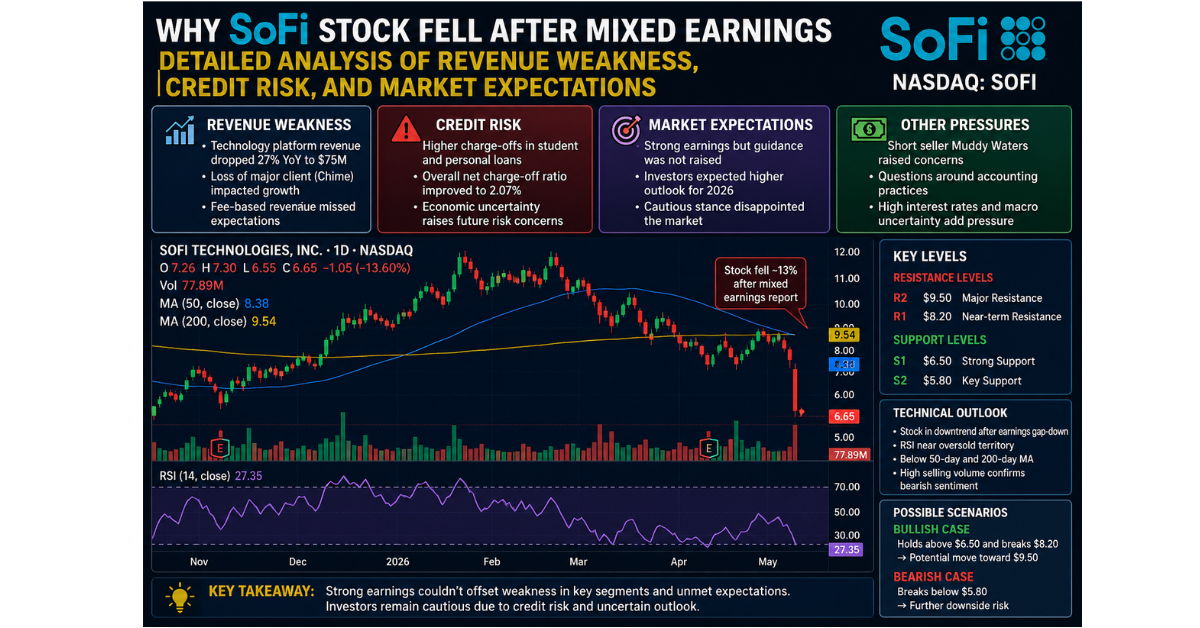
The sharp decline in SoFi Technologies (SOFI) following its latest earnings report highlights a classic market paradox where strong financial performance fails to satisfy investor expectations. The company reported impressive growth, with adjusted net revenue rising 41% year over year to a record $1.1 billion, alongside improving profitability. Under normal circumstances, such results would boost investor confidence. However, in this case, the market reaction was driven not by what SoFi achieved, but by what it failed to deliver relative to expectations.
Technology Platform Revenue Decline Raises Concerns
A major red flag came from SoFi’s technology platform segment, where revenue dropped 27% to $75 million. This division is considered a critical long-term growth engine because it offers scalable, high-margin banking infrastructure services. The decline was largely due to the departure of a key client, Chime, which had previously relied on SoFi’s platform. This loss not only impacted current revenue but also raised broader concerns about customer concentration risk and the sustainability of this business segment moving forward.
https://finance.yahoo.com/quote/SOFI/chartFee-Based Revenue Miss Signals Slower Diversification
Another concern came from SoFi’s financial services segment, which includes products like investing, credit cards, and banking solutions. Although fee-based revenue grew 23% to $387 million, it fell short of analyst expectations. This miss suggests that SoFi’s efforts to diversify beyond lending are progressing more slowly than investors had hoped. Since long-term growth depends on reducing reliance on lending, this underperformance added to negative sentiment.
Guidance Disappointment Weighs Heavily
One of the most significant factors behind the stock drop was management’s decision to maintain its full-year 2026 outlook instead of raising guidance. Investors had anticipated an upgrade given the strong quarterly results. By keeping projections unchanged, SoFi signaled caution, which the market interpreted as a lack of confidence in sustaining growth momentum amid uncertain macroeconomic conditions.
Credit Risk Remains a Key Investor Concern
Investor concerns around credit risk continue to play a major role in SoFi’s valuation. The company has significant exposure to personal and student loans, making it sensitive to economic downturns. While SoFi reported an improvement in its overall net charge-off ratio, rising defaults in certain loan categories remain a concern. Additionally, its risk management model has not yet been tested in a severe recession, which adds another layer of uncertainty for investors.
lmpact of Short Seller Allegations
External pressures have also influenced investor sentiment. Earlier this year, Muddy Waters Research disclosed a short position in SoFi and raised concerns about aggressive accounting practices and potential hidden risks. Although SoFi strongly denied these allegations, such claims tend to create doubt in the market and contribute to increased volatility.
Market Psychology — Expectations vs Reality
From a broader perspective, the reaction to SoFi’s earnings underscores the importance of expectations in the stock market. Investors were not only looking for strong financial results but also for confirmation of accelerating growth across all segments and a more optimistic forward outlook. Instead, they received a mixed picture—strong performance in lending and profitability, but weakness in key strategic areas like the technology platform and financial services.
Macro Environment Adds Pressure
The current macroeconomic environment has further amplified concerns. High interest rates, potential tightening of credit conditions, and global economic uncertainty make investors more cautious toward fintech companies with significant lending exposure. This backdrop makes even minor weaknesses in earnings reports more impactful on stock prices.
Final Interpretation of the Sell-Off
As a result, despite delivering what would traditionally be considered strong earnings, SoFi Technologies (SOFI) faced heavy selling pressure. The combination of unmet expectations, segment-specific weaknesses, cautious guidance, and broader market concerns led investors to reassess the company’s near-term growth trajectory.
In today’s market, strong results alone are not enough — companies must exceed expectations and reinforce confidence in future growth to sustain stock momentum.