
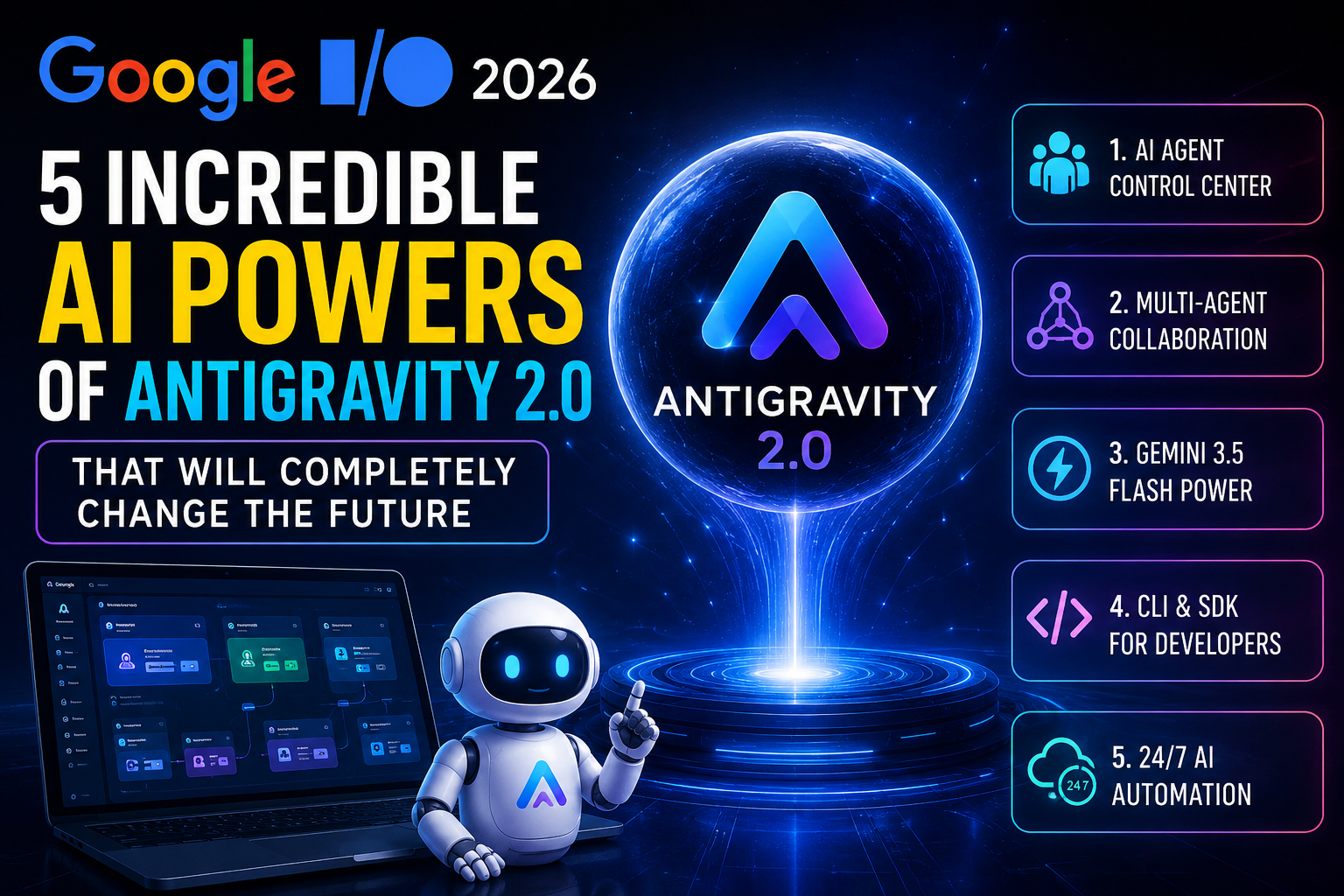
Google’s new AI platform, Google Antigravity 2.0, was one of the biggest announcements at Google I/O 2026. The idea behind the “AI on steroids” description is that Google is moving from simple chatbots to autonomous AI agents that can plan, act, and work together.
1. Antigravity 2.0 becomes an AI agent control center
Instead of chatting with one AI at a time, users can manage multiple AI agents running parallel tasks. Google describes it as a desktop hub where agents can coordinate work, automate tasks, and handle long-running projects.
2. Multi-agent teamwork
Antigravity can create dynamic sub-agents that split large jobs into smaller tasks. This allows different AI agents to work simultaneously on coding, testing, planning, and research, speeding up complex workflows.
3. Faster AI with Gemini 3.5 Flash
Google integrated Gemini 3.5 Flash into Antigravity. The company says it is optimized for agentic tasks and coding, delivering much faster responses than previous frontier AI systems.
4. CLI and SDK for developers
Google launched an Antigravity CLI and SDK, allowing developers to build custom AI workflows, host their own agents, and deploy them on their own infrastructure. This turns Antigravity into a full development platform rather than just a coding assistant.
5. Background automation and 24/7 AI agents
Antigravity powers services like Gemini Spark, which can run continuously in the cloud. These agents can monitor tasks, manage workflows, and continue working even when the user is offline.
Why it matters
Google is pushing toward what it calls the “Agentic Gemini Era,” where AI does more than answer questions—it can complete multi-step tasks, coordinate with other agents, and work across apps and services. Antigravity is becoming the backbone of that vision.
For official details, see: