
Humanoid robots are becoming more powerful and intelligent every year, and now Boston Dynamics has revealed new details about its advanced humanoid robot “Atlas.” The company says the next-generation Atlas robot is specifically designed for real industrial work and can perform difficult physical tasks that many humanoid robots still struggle with.
According to Boston Dynamics, Atlas features a simplified hardware architecture that makes robot simulation, movement training, and performance testing much more accurate and efficient.
One of the biggest improvements in the new Atlas robot is its symmetrical body design. The humanoid uses only two actuator types across its entire body, while both arms and legs share the same structure. This design helps engineers reduce mechanical complexity and improve overall movement control.
The company also removed cables running across the robot’s joints. Because of this, Atlas can rotate its joints continuously without causing heavy wear and tear. This allows the humanoid robot to move more freely and perform actions that traditional robots often cannot achieve.
Boston Dynamics explained that the updated design gives Atlas better flexibility, smoother motion, and stronger durability for real-world industrial environments.
Table of Contents
Atlas Built for Heavy Industrial Tasks
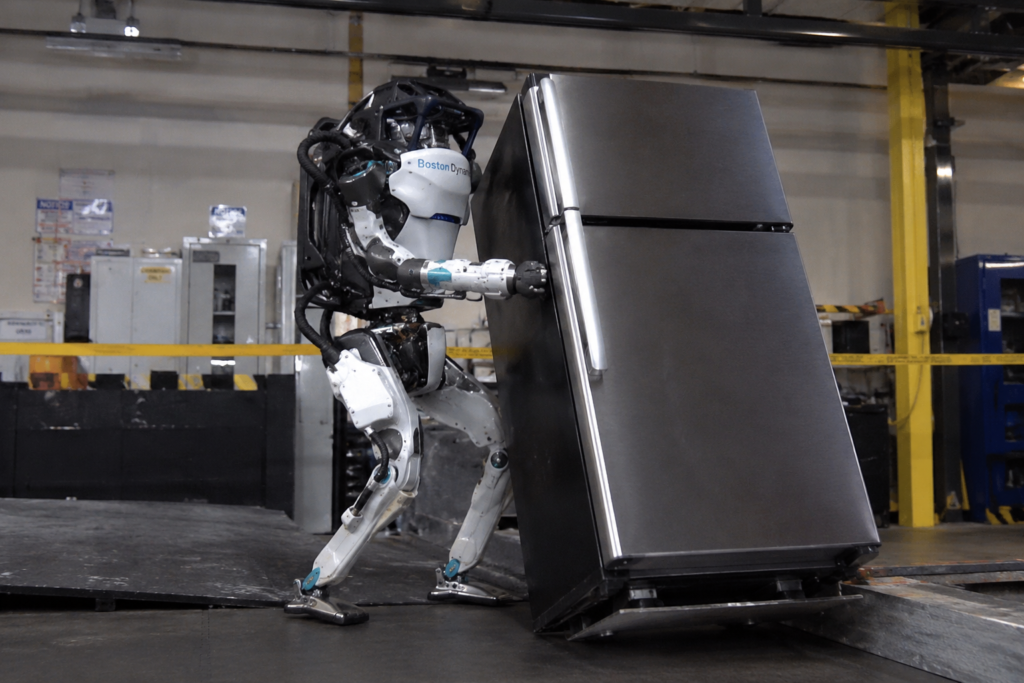
Boston Dynamics revealed that Atlas was trained using loads weighing between 50 and 70 pounds. However, during testing, the humanoid robot successfully lifted and moved a refrigerator weighing more than 100 pounds.
The company said handling heavy objects requires more than simple arm strength. Atlas must understand weight distribution, body balance, and movement coordination similar to humans.
“You cannot lift a fridge just by looking at it and using your hands,” Boston Dynamics explained. “You have to prepare for it, anticipate the weight, lean into it, and let your body do the work.”
This statement highlights how advanced humanoid robots are beginning to learn physical intelligence instead of simply following fixed programming commands.
Future of Humanoid Robots
Experts believe robots like Atlas could soon become common in:
Warehouses
Factories
Logistics centers
Construction sites
Manufacturing industries
Many companies worldwide are investing heavily in humanoid robotics to solve labor shortages and improve workplace safety.
Boston Dynamics has spent years developing Atlas as one of the world’s most advanced humanoid robots. Earlier versions became famous for performing backflips, running, jumping, and obstacle navigation. However, the newest version focuses more on practical industrial work instead of demonstrations.
Technology analysts believe humanoid robots may eventually work alongside humans in physically demanding jobs where strength, balance, and intelligent movement are required.
As artificial intelligence and robotics continue improving, Atlas represents another major step toward a future where humanoid robots become part of everyday industrial operations.