
Nvidia’s N1 ;The race to define the future of personal computing has taken a dramatic turn. Nvidia, long dominant in the GPU market, has now confirmed its entry into the AI PC processor space with the upcoming N1 and N1X chips. These new processors, developed in partnership with MediaTek, signal a direct challenge to Intel and AMD, who have traditionally held sway over the CPU market. With AI workloads becoming central to modern computing, Nvidia’s move could reshape the competitive landscape of PCs over the next decade.
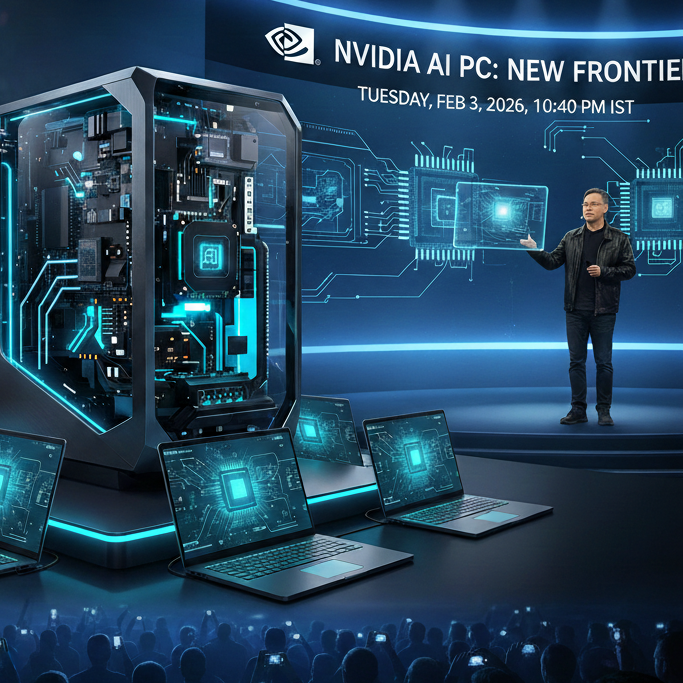
Nvidia’s Strategic Leap & Nvidia’s N1
For years, Nvidia has been synonymous with high‑performance graphics cards and data center AI accelerators. But the announcement of the N1 and N1X chips marks its first serious attempt to power mainstream PCs with processors designed from the ground up for artificial intelligence. According to reports, the N1 will target general AI PCs, while the N1X will serve as a higher‑end option, potentially aimed at premium laptops and workstations.
The chips are built on ARM architecture, a departure from the x86 designs that Intel and AMD rely on. This choice reflects Nvidia’s belief that ARM’s efficiency and flexibility make it better suited for AI‑driven workloads. By leveraging MediaTek’s expertise in mobile SoCs, Nvidia hopes to deliver chips that balance performance with power efficiency—an essential requirement for laptops and portable devices.
MediaTek Partnership and TSMC Talent
Nvidia’s collaboration with MediaTek is more than a technical alliance; it’s a strategic maneuver. MediaTek has deep experience in designing ARM‑based processors for smartphones and tablets, and its integration into the PC space could accelerate Nvidia’s roadmap. Jensen Huang, Nvidia’s CEO, has touted this partnership as a cornerstone of the company’s AI PC ambitions.
Adding to the momentum, Nvidia has recruited a new vice president from TSMC, the world’s leading semiconductor foundry. This move underscores Nvidia’s intent to secure manufacturing expertise at a time when chip supply chains remain volatile. With TSMC’s cutting‑edge process nodes, Nvidia’s N1 and N1X chips could benefit from advanced fabrication technologies, giving them a competitive edge in performance and efficiency.
Challenges on the Horizon
Despite the excitement, Nvidia’s path is not without obstacles. Reports from Notebookcheck suggest that the N1X APU is facing software issues, causing delays in laptop launches until Q2 or summer 2026. Such setbacks highlight the difficulty of entering a market long dominated by x86 compatibility. Software ecosystems, driver stability, and developer support will be critical for Nvidia’s success.
Moreover, Intel and AMD are not standing still. Both companies have already announced AI‑focused PC chips, with Intel’s Core Ultra series and AMD’s Ryzen AI processors aiming to embed neural processing units (NPUs) directly into consumer devices. Nvidia will need to prove that its ARM‑based approach can deliver superior performance and compatibility across Windows and other platforms.
Implications for the AI PC Market (Nvidia’s N1 )
The arrival of Nvidia’s N1 and N1X chips could accelerate the adoption of AI PCs, devices designed to run machine learning tasks locally rather than relying solely on cloud services. This shift has profound implications:
- Enhanced Productivity: AI PCs could enable real‑time transcription, translation, image generation, and other tasks without internet dependency.
- Privacy and Security: Local AI processing reduces reliance on cloud servers, keeping sensitive data on the device.
- New Applications: Developers may create software that leverages on‑device AI for creative, educational, and professional use cases.
If Nvidia succeeds, the definition of a “PC” could evolve from a general computing device into a personalized AI companion.
Conclusion
Nvidia’s confirmation of the N1 and N1X chips represents a pivotal moment in the evolution of personal computing. By combining MediaTek’s design expertise, TSMC’s manufacturing prowess, and its own AI leadership, Nvidia is positioning itself to challenge Intel and AMD in their core territory. Yet, software hurdles and ecosystem adoption remain significant challenges.
The next two years will determine whether Nvidia’s gamble pays off. If the N1 and N1X deliver on their promise, they could usher in a new era of AI‑powered PCs—where intelligence is not just in the cloud, but embedded directly into the heart of our devices.